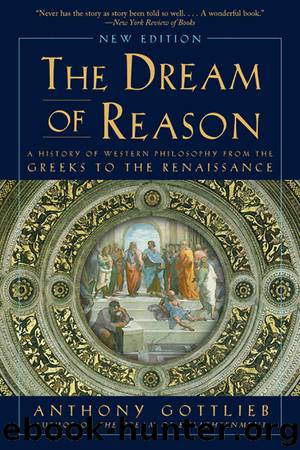
The Dream of Reason: A History of Western Philosophy from the Greeks to the Renaissance (New Edition) by Anthony Gottlieb
Author:Anthony Gottlieb [Gottlieb, Anthony]
Language: eng
Format: azw3
Publisher: W. W. Norton & Company
Published: 2016-08-29T16:00:00+00:00
Most of Aristotle’s abstract discussions about motion, time, change and the Unmoved Mover are to be found in his treatises on physics, cosmology and biology. Such reflections were an intrinsic part of science as a whole; they arose naturally in the course of his attempts to understand the world. But they also cropped up in another context that is now sometimes regarded as far from the territory of science. Several of Aristotle’s arguments on these subjects were developed in a set of treatises to which a later editor gave the name of Metaphysics. At the time, this term simply denoted that these books came after (meta) the ones that were classified as ‘physics’; it was merely a librarian’s term. But the word has since taken on a life of its own. By medieval times, ‘metaphysics’ had come to denote a special branch of inquiry that was radically different from ‘natural philosophy’ (i.e., science). ‘Metaphysical’ came to mean ‘transcending physics’. For some later philosophers who were sceptical about the possibility of such transcendence, especially David Hume in the eighteenth century and the logical positivists in the twentieth century, ‘metaphysician’ became more or less a term of abuse. A metaphysician was one who concocted abstruse and sophistical conundrums; his work was mere intellectual doodling that could not lead anywhere because it ignored empirical evidence and scientific knowledge. ‘Metaphysical’ is now also sometimes used to mean ‘occult’.
To understand what Aristotle was up to in this work, it is best to ignore such later connotations of the term. The fourteen of his books collected together under the title of Metaphysics are a rag-bag of topics. They include a lengthy attack on Plato’s pseudo-mystical account of mathematics, in which Aristotle argues that numbers, points, triangles and so on should be considered as abstractions in the mind rather than as mysterious objects which somehow exist in their own right. They also include a lexicon in which Aristotle explores the various senses of thirty of the central terms used in his investigations, such as ‘substance’, ‘disposition’, ‘quality’, ‘opposite’, ‘whole’, ‘impossible’ and ‘false’. In other parts of the Metaphysics he expounds his doctrine of the four causes and relates it to the ideas of earlier thinkers; he develops his ideas about the difference between form and matter; he talks about the principles of classification and definition and discusses the concepts of unity and diversity; he tries to work out some mathematical details of astronomy; he talks about his God; and—among other things—he attacks scepticism and relativism, and discusses such basic logical principles as ‘no proposition is both true and false at the same time’.
These are very disparate bedfellows, it seems, but there was one theme which united at least most of them in Aristotle’s mind. In a couple of places in the Metaphysics, he speaks of a subject which he calls ‘First Philosophy’. Roughly speaking, it seems intended to cover the most general of principles, causes and concepts. It deals with universal questions that are common to all
Download
This site does not store any files on its server. We only index and link to content provided by other sites. Please contact the content providers to delete copyright contents if any and email us, we'll remove relevant links or contents immediately.
| Anthropology | Archaeology |
| Philosophy | Politics & Government |
| Social Sciences | Sociology |
| Women's Studies |
The remains of the day by Kazuo Ishiguro(9006)
Tools of Titans by Timothy Ferriss(8404)
Giovanni's Room by James Baldwin(7356)
The Black Swan by Nassim Nicholas Taleb(7137)
Inner Engineering: A Yogi's Guide to Joy by Sadhguru(6801)
The Way of Zen by Alan W. Watts(6621)
The Power of Now: A Guide to Spiritual Enlightenment by Eckhart Tolle(5791)
Asking the Right Questions: A Guide to Critical Thinking by M. Neil Browne & Stuart M. Keeley(5779)
The Six Wives Of Henry VIII (WOMEN IN HISTORY) by Fraser Antonia(5520)
Astrophysics for People in a Hurry by Neil DeGrasse Tyson(5196)
Housekeeping by Marilynne Robinson(4456)
12 Rules for Life by Jordan B. Peterson(4315)
Ikigai by Héctor García & Francesc Miralles(4280)
Double Down (Diary of a Wimpy Kid Book 11) by Jeff Kinney(4278)
The Ethical Slut by Janet W. Hardy(4264)
Skin in the Game by Nassim Nicholas Taleb(4258)
The Art of Happiness by The Dalai Lama(4133)
Skin in the Game: Hidden Asymmetries in Daily Life by Nassim Nicholas Taleb(4013)
Walking by Henry David Thoreau(3970)
